

How To Keep Drinking Water Clean Future Systems
The provision of clean, condom drinking water in much of the earth is one of the most significant public wellness achievements of the by century – and ane of the foundation stones of a healthy society. In the developed world, about people are able to take this service for granted and pay very trivial for it.
Only fifty-fifty if in that location is not a large economic price, a global environmental cost is being paid for the luxury of this service. Water systems extract big quantities of water from the surroundings, crave energy, chemicals and infrastructure to treat and pump water to our houses, so require more energy and infrastructure to remove waste product, treat information technology, and return some of that water to the surroundings consummate with contaminants (at depression levels, but still present).
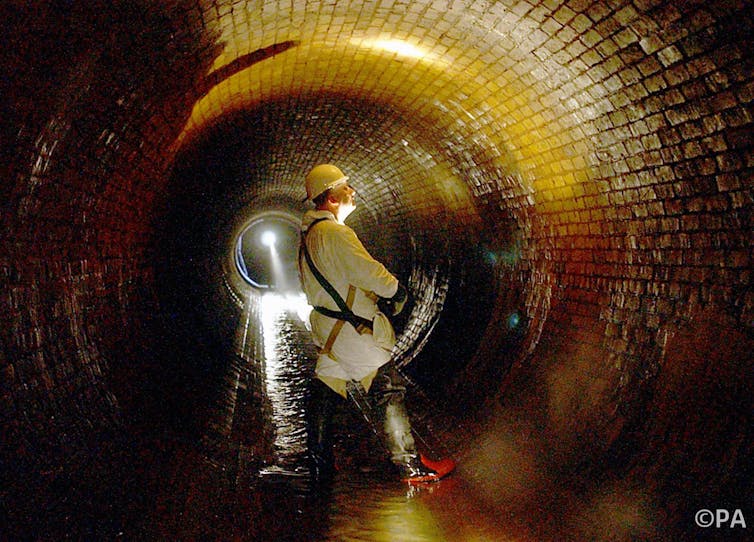
In the UK, h2o services are based on legacy infrastructure systems; the country lives off Victorian engineering science. These systems are ageing and deteriorating and will require unprecedented investment to exist fit for the future. Therefore the country needs to reimagine its h2o services to deliver water sustainably via systems that are affordable, adaptable and resilient.
Water security under threat
Global population growth is threatening the security of water supply and when coupled with the impacts of climate change, it is clear that our historical approach to the provision of h2o may not remain feasible. Increasingly stringent drinking water quality and environmental discharge standards protect usa from pollutants but require increasingly complex and energy-consuming handling. Leakage of h2o from ageing infrastructure wastes more of this precious resource, yet the costs of replacing that infrastructure seem insurmountable.
Perhaps information technology is fourth dimension to reconsider the one-size-fits-all arroyo of large centralised infrastructure and instead pursue a suite of solutions tailored to local needs. Could information technology exist possible to accept water systems that accept no adverse affect on the environment, or meliorate yet – water systems with positive impacts for people, social club, the environment and the economy?
Such a transformation of water systems will require new applied science but besides new ways for people to interact with h2o. Research into treatment technologies such as low-pressure level membrane systems that will piece of work nether gravity flow without pumps could have cracking potential for treating a variety of water sources at a variety of scales.
But will people want to install a device in their homes to create drinking water from, for example, rainwater in their neighbourhood pond? And what regulatory and policy frameworks would be required to enable this? In that location is a need for such devices to be engineered to exist fail-safe to protect public health in the consequence of equipment malfunction.
Crowdsourcing change
Mobilisation of people could offer great transformative potential for our water systems. For example, engineering researchers are working to design treatment systems to remove fats, oils and grease from sewers before they cause major blockages, known every bit "fatbergs". Yet, such engineering would not be required if all users of the organisation jointly protected the infrastructure past disposing of fats in another way.
And so the sustainable h2o systems of the future also need the confusing innovation of collective mobilisation to deliver and support transformation. Energy-saving measures are beingness implemented throughout urban water systems including pumping at non-peak times and recovering estrus from wastewater. But there is potential for a closer linkage between the water and energy systems by considering the synergies between distribution systems for both utilities.
The drive to install renewable energy is stressing the electric grid and distribution systems, which were not designed to handle the decentralised sources and variable inputs that characterise renewables such as solar and air current power. The opportunity exists for water systems, which operate at the neighbourhood level only like electricity networks, to be configured to act as energy storage systems to starting time the variability in electric power generation to store heat or energy in the form of pressurised water. Research is ongoing to decide the full potential and optimal scales for such interactions between water and electric grids but could offer a way to optimise existing infrastructure for both utilities.
These examples give some insight into how applied science volition exist essential to transform our current unsustainable systems to deliver adaptable and resilient water services across a range of futures and contexts. Large, centralised infrastructure may still be required in densely populated areas – in these situations disruptive solutions demand to work with the existing systems because high population density does not allow for land-intensive solutions and legacy infrastructure is too expensive to simply abandon.
Given the l-to-100-year service life for water infrastructure, a change in philosophy is needed now to avoid another century of unsustainable h2o service. Such confusing innovations, when combined in a way to arrange each singled-out context, could evangelize sustainable h2o solutions for all – from megacities to remote rural communities, to the quickly developing parts of the world.

Source: https://theconversation.com/how-to-achieve-sustainable-clean-water-for-everyone-59025
Posted by: goodloehatheyn41.blogspot.com
0 Response to "How To Keep Drinking Water Clean Future Systems"
Post a Comment